

- Hubei New Desheng Material Technology Co., Ltd
- Main Products: blood collection tube additives, chemiluminescent reagents, biological buffers, chromogenic substrates
-
 Doris Yang
Hi there! Welcome to my shop. Let me know if you have any questions.
Doris Yang
Hi there! Welcome to my shop. Let me know if you have any questions.
Your message has exceeded the limit.
The use and preparation method of PIPES powder as a biological buffering agent
2025-09-18 16:13:33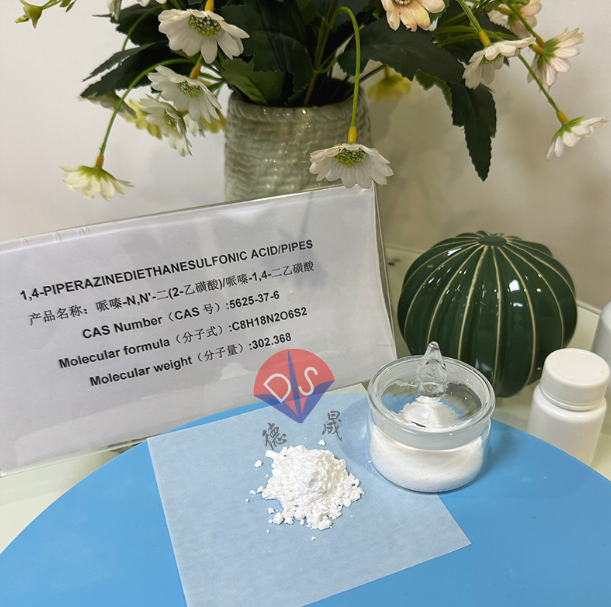
PIPES powder, a biological buffering agent, is a widely used chemical reagent in biological experiments. Its full name is piperazine-1,4-diethylsulfonic acid. As a biological buffering agent, PIPES solution plays an important role in maintaining the stability of the intracellular environment and protecting cells from pH fluctuations. This article will provide a detailed introduction to the properties, uses, and preparation methods of PIPES powder, a biological buffering agent.
PIPES is a white powdery chemical reagent with the chemical formula C8H12N2O4S and a molecular weight of 248.26. It is a zwitterionic buffering agent with stable pH buffering ability, capable of maintaining a certain pH value in acidic or alkaline environments. In addition, PIPES has high ionic strength and low permeability, making it widely used in biological experiments such as cell culture, electrophoresis, and immunoblotting.
Application of Biological Buffer PIPES in Biological Experiments
PIPES powder, as a biological buffering agent, has been widely used in many biological experiments. Here are several typical application areas:
1. Cell culture: In cell culture experiments, PIPES can be used as a pH buffer to maintain the stability of the pH value of the culture medium, ensuring the normal growth and division of cells. It can serve as an ion carrier to facilitate the exchange of ions inside and outside the cell, affecting the physiological functions of the cell.
2. Electrophoresis: In electrophoresis experiments, PIPES powder can be used as a molecular sieve and ion exchanger to improve the resolution and effectiveness of the experiment. For example, in protein electrophoresis experiments, PIPES can bind to proteins, slowing down their movement in an electric field and improving the resolution of the experiment.
3. Immunoblotting: In the immunoblotting experiment, PIPES can be used as the main component of the transmembrane buffer to help transfer proteins from the gel to the membrane. Meanwhile, PIPES can also serve as an ion carrier to enhance the sensitivity and specificity of experiments.
4. Purification of microtubule protein: In microtubule protein purification experiments, PIPES can be used as the main component of the buffer to assist in the extraction and purification of microtubule protein from tissues. It can also inhibit the polymerization reaction of microtubule proteins and improve purification efficiency.
5. Peroxisome localization: In the peroxisome localization experiment, PIPES can serve as the main component of the buffer to assist in the ultrastructural localization of peroxisomes in cells. It can also protect cells from damage caused by peroxisomes.
In addition to the aforementioned application areas, PIPES can also be applied in biological experiments such as the separation and purification of nucleic acids and proteins, protein crystallization, tissue culture, and drug screening. In short, as an important biological buffer, it plays an indispensable role in many biological experiments.
Preparation method of PIPES biological buffer
1. Prepare the required reagents and equipment
PIPES powder, ultrapure water, glass bottle, weighing paper, electronic balance, magnetic stirrer or vortex oscillator.
2. Weighing PIPES powder
Accurately weigh PIPES powder using an electronic balance based on the required concentration and volume. For example, if 100 mL of 0.25 mol/L PIPES solution needs to be prepared, 25.7g of PIPES powder needs to be weighed.
3. Dissolve PIPES powder
Add the weighed PIPES powder into a glass bottle, add an appropriate amount of ultrapure water, and then stir with a magnetic stirrer or vortex oscillator until dissolved. Note that sufficient ultrapure water should be used to ensure complete dissolution.
4. Filtering and sterilization
Filter and sterilize the pre configured PIPES solution to remove impurities and bacteria from the solution. Disposable syringes or filters can be used for filtration.
5. Storage and use
Store the filtered PIPES solution in a clean glass bottle and store it in a refrigerator at 4 ℃. When using, an appropriate amount of PIPES solution should be added according to experimental requirements.
Precautions for using PIPES biological buffer
1. PIPES powder has hygroscopicity, so it should be stored in a dry environment to avoid moisture;
2. During the configuration process, ultrapure water or deionized water should be used to ensure the purity and quality of the solution;
3. The prepared PIPES solution should be a colorless and transparent liquid. If turbidity or precipitation occurs, it may be due to incomplete dissolution of the powder or impurities, and should be reconfigured;
4. The prepared solution should be used up within the specified time to avoid prolonged storage that may affect the quality and effectiveness of the solution.
Desheng is a manufacturer of PIPES powder with high purity and stable quality, which can be provided in large quantities. More than 30 different buffer products can be provided, and other biological buffer products can also be purchased in one stop. Feel free to contact us anytime if you need it!
Tags: PIPES buffer, 5625-37-6, biological buffering agent
 Business License